
 Last Update:
June 15, 2026
Last Update:
June 15, 2026
The Estadi Ciutat de Valencia, home to Levante UD, is widely regarded as one of the more welcoming and authentic away-day experiences in La Liga.
Situated in the Orriols neighbourhood in the north of Valencia, it is a compact and intimate ground that feels very much like a proper football stadium rather than a modern multipurpose arena, and visiting supporters tend to respond well to that.
Away fans are typically housed in the Gol Alboraya stand at the northern end of the ground. The allocation is generally sufficient for most travelling supporters, and the stand offers a good view of the pitch, as the ground is tightly configured with the stands close to the playing surface.
Between 2007 and 2010, a shopping centre was built along the eastern stand, and in the summer of 2016, the club carried out a complete replacement of the seats throughout the stadium, painting sections of the structure in club colours. Between 2020 and 2021, a new roof was installed covering all four stands, and two large video screens were added at the same time.
The Granota fans in the main stand are known for creating a wall of noise, and although the stadium is not the largest in La Liga, its compact nature helps to amplify the atmosphere considerably.
There are rarely any serious incidents of trouble at the Estadi Ciutat de Valencia, and the general consensus among away supporters is that it is a safe and enjoyable place to visit.
- Poco A Poco
- Per Sempre Amunt Llevant
- Todo El Estadio Blaugrana
- Jugadores, Jugadores
- Himno Del Levante
Ciutat de Valencia can be thought of as four sections: Gol Alboraya (North), Grada Central (East), Gol Orriols (South) and Tribuna (West).
The best views are found in the Tribuna (West Stand), which is the main stand running along the side of the pitch. This is where the press box and hospitality areas are located, and it provides the widest and most comfortable perspective on the match.
The Grada Central (East Stand) on the opposite side of the pitch is similarly well-positioned.
The Gol Alboraya (North Stand) is where visiting fans are typically housed, usually in a designated upper corner sector.
The Gol Orriols (South Stand) at the opposite end is where the most vocal home supporters and active fan groups gather during matches.
Estadi Ciutat de Valencia seating plan
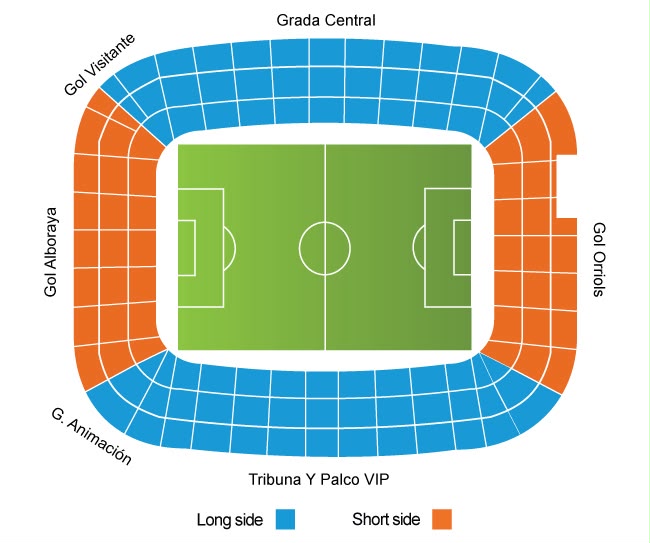
- It is worth noting that there are relatively few bars or restaurants in the immediate vicinity of the stadium, and most visiting supporters find it preferable to eat and drink in Valencia’s historic city centre or along the beaches before making their way to the ground.
- Finnegans of Dublin – A well-regarded Irish pub in the heart of Valencia, popular with travelling supporters.
- Mulligan’s Irish Pub is another solid option for visiting fans looking for a pre-match drink in a familiar setting.
- Cafe Negrito – A lively bar with cheap drinks and a great atmosphere, popular with locals and visitors alike.
Food and drink is available inside the stadium before kick-off and at half time. The offering is typical of a La Liga ground – hot snacks, bocadillos (sandwiches), burgers, fries and soft drinks.
Valencia is one of the great food cities of Spain, and the city centre has an exceptional range of restaurants, tapas bars and markets. If you are visiting for a weekend, the Mercado Central – one of Europe’s finest covered food markets – is an unmissable stop.
The waterfront district of La Marina and the streets around Barrio del Carmen are both excellent for pre-match dining.
Bar Avenida (located on Carrer de Santiago Rusinol) is a popular local spot just a two-minute walk from the ground where you can enjoy a drink and snacks before the match.
The Estadi Ciutat de Valencia is located in the north-east of the city, approximately 2.5 kilometres from the historic city centre and around 3.5 kilometres from the main railway station. The walk from Valencia’s cathedral to the stadium takes around 30 minutes on foot.
By tram
Tram Line 6 stops directly in front of the main entrance of the stadium at the stop Estadi del Llevant, making it the most convenient public transport option for supporters arriving from the eastern part of the city or from the coast.
By metro
Metro station Machado on Lines 3 and 9 is a 10-minute walk from the ground and offers easy connections from the city centre and the main railway station.
By car
The stadium is situated on the northern edge of the city and is reasonably accessible by car, though parking can be a challenge on matchdays and street spaces in the surrounding residential streets tend to fill up quickly. Arriving early is strongly recommended. If approaching from the north-east on the Autovia V-21/E-15, take the Ronda Nord (northern ring road) and follow it until the stadium appears on the left. If approaching from the south or west, follow signs for the Ronda Nord and continue until the stadium is visible on your right.
By plane
Valencia/Manises Airport is approximately 10 kilometres west of the city centre and around 14 kilometres from the stadium. Metro Lines 3 and 5 provide a direct connection from the airport into the city centre, from where the stadium can be reached by tram or metro.
Tickets to see Levante UD can be purchased through the club’s official website at levanteud, at the stadium ticket office, or through authorised third-party vendors.
As Levante do not consistently sell out at home outside of the biggest fixtures, it is often possible to purchase tickets on the day of the match, though this is not guaranteed for high-demand games such as the Derby del Turia against Valencia CF.
Prices are competitive by La Liga standards, with tickets behind the goal available from around €15–20, rising to €30–45 or more for central main stand seats. Prices increase for marquee fixtures.
Levante UD is the oldest football club in the city of Valencia, having been founded on 6 September 1909 – a full decade before Valencia CF was established. The club played at several grounds in its early years, most notably the Estadio de Vallejo from 1925, which served as their home until 1968 and held a capacity of 18,000.
The Estadi Ciutat de Valencia was inaugurated on 9 September 1969, marking a significant moment in the club’s history. Designed to accommodate the surging popularity of football in Spain, the stadium featured single-tiered stands and a covered main grandstand, initially holding around 25,000 spectators.
The stadium was originally named the Estadio Antonio Roman upon opening, before being renamed Nou Estadi del Llevant in 1972, a name it held until 1999 when it became the Estadi Ciutat de Valencia – reflecting the club’s home city and identity.
Over the years the stadium became outdated, requiring significant improvements to comply with La Liga’s broadcasting requirements and to offer fans a better matchday experience. A major renovation programme was carried out between 2020 and 2021, transforming the ground considerably.
The project introduced a new roof covering all four stands, advanced 4K-compatible lighting, large video scoreboards and improved accessibility facilities.
The stadium has hosted the Spain national football team on selected occasions and served as a temporary home for Villarreal CF in 2022 during renovation works at their own ground. It has also established itself as the third most active stadium in Spain for concerts and events, surpassed only by the Civitas Metropolitano and Santiago Bernabeu in Madrid.
Record attendance
30,000 – Levante UD vs Atletico Madrid (19 August 2012)
- 2025/26: 20,211 (La Liga)
- 2024/25: 15,995 (Segunda Division)
- 2023/24: 14,226 (Segunda Division)
- 2022/23: 14,084 (Segunda Division)
- 2021/22: 14,964 (La Liga)
- 2020/21: 4,900 (La Liga)
Stadium tours are available at the Estadi Ciutat de Valencia and can be booked via the club’s official website at levanteud.com or by contacting the club directly.
The tour takes in the key areas of the stadium behind the scenes, including the dressing rooms, the players’ tunnel and the pitch side.
Throughout its history, the stadium has also hosted concerts by internationally renowned artists – including The Police, Simple Minds, Alejandro Sanz and Maluma among others – making it a well-established events venue beyond its primary use as a football ground.
For up-to-date information on tour availability, pricing and scheduling, visiting levanteud.com directly is recommended.
Reviews
Be the first to leave a review of Levante UD Stadium!
Why not write your own review of this ground and have it included in the Guide? Find out more about submitting a Fans Football Ground Review.