
 Last Update:
August 31, 2026
Last Update:
August 31, 2026
The Jan Breydel Stadium is a compact stadium that is often well-liked by visiting supporters. It has two tiers all the way round, but the open corners make it look like an old-school English football stadium.
Away fans visiting the Jan Breydel Stadium are typically placed in the south-east corner. To enter this section of the stadium, fans need enter via entrance four across turnstiles 421 and 422.
A typical allocation for away supporters in this section is only around 1,500 and it is wedged in between two sections of home supporters so it can be quite intimidating. Part of the away end is also uncovered so bring an umbrella and/or a coat if rain is forecasted.
The view from the pitch in this section SHOULD be good, however, the club often place netting in front of the away end and to the side to prevent missiles from being thrown to/from it.
Jan Breydel Stadium:
(Club Brugge ??)
Away end:
Half covered / half no roof.
Covered section – can hardly see nearest goals or corner!
Open section – yes it’s absolutely pouring down! #Mufc ?? pic.twitter.com/LMiskUrIvx— Peter Bolton ?? (@PeterBolton3) February 20, 2020
Sharing a stadium has not stopped Club Brugge and Cercle Brugge from developing their own matchday identities, with both sets of supporters having their own songs and chants.
Club Brugge
For Club Brugge, “Come On FCB” and “Blauw-en-Zwart forever ” are among the chants listed in FanChants’ catalogue, alongside songs such as “Boeren!” and “Bruges ’til I Die”.
Cercle Brugge chants
Cercle Brugge have their own collection of songs, including “Come On Cercle, Come On!” and “‘t Stienkt Ier No Vis”, although the latter is specifically used when the club visits teams on the Belgian coast, so it is not one to expect regularly at Jan Breydel.
Jan Breydel is split into four main stands, with the North, South, East and West tribunes surrounding the pitch. The West Stand contains the main entrance and hospitality facilities, while the stadium’s two-tier layout gives supporters a range of viewing positions.
For the clearest overall view of the pitch, seats along the sides of the ground are generally the best option, particularly from a higher position. Supporters looking for more of the matchday noise can instead look behind the goals, although the atmosphere will depend on which club is designated as the home side for the fixture.
It is also worth bearing in mind that Jan Breydel is not fully covered. Club Brugge note that almost half of the stands are uncovered, so supporters should check their specific seating area and come prepared if the forecast is looking wet.
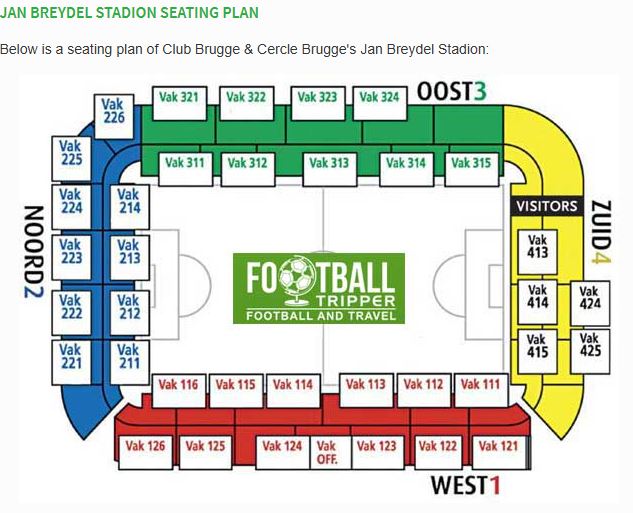
The overall capacity of the Jan Breydel Stadium is 29,062. As mentioned above, away fans are typically only given around 1,500 tickets of this capacity.
The most notorious stand for home supporters at the stadium is the North Stand, which is opposite the away end. Both the East and West Stands hold hospitality spaces, with the West Stand considered the stadium’s main stand.
Since the mid-2000s, Club Brugge have pushed forward to build a new 40,000-seater stadium to replace the current facility. The Jan Breydel Stadium has become outdated, and the club have tried to push through various planning applications and permits to make the new stadium a reality in recent years. Included in the plans is a 12,500 capacity North Stand, inspired by the “Yellow Wall” at Borussia Dortmund’s Signal Iduna Park.
Club Brugge received an environmental permit for the new stadium in June 2024 – a key step in the club’s mission to build a modern facility to replace the current ground.
Jan Breydel Stadium is in Sint-Andries, away from Bruges’ historic centre, so the immediate area is more residential and has fewer drinking options than the city centre.
Near the stadium, options include:
- De Vriendschap on Gistelse Steenweg — a traditional local eetcafe serving drinks and straightforward food.
- Sweet Home Lunch at Gistelse Steenweg 482 — more suited to daytime visits, with Tuesday hours running from early morning through to late afternoon.
Fans with more time before the match will find a much wider choice in the historic centre, including:
- ‘t Brugs Beertje on Kemelstraat — one of Bruges’ best-known spots for Belgian beer.
- De Garre — another well-known beer bar in central Bruges.
Belgium’s beer culture is a big part of a visit to Bruges, and supporters will find plenty of places in the city centre where they can try Belgian beers before making their way to the stadium.
Popular food options around Bruges include:
- Frites from a frituur — one of Belgium’s best-known casual foods, served with a wide range of sauces, including mayonnaise, andalouse and stoofvleessaus.
- Waffles — widely available from street vendors, specialist shops and cafes across the city centre.
- Mussels (moules-frites) — a Belgian classic that is widely served in restaurants around the historic centre.
For drinks, Bruges has no shortage of options:
- Belgian beer — the city centre is packed with bars offering a wide range of Belgian beer styles, including Brugse Zot from Bruges’ own De Halve Maan brewery.
- ‘t Brugs Beertje — one of Bruges’ best-known beer bars, with around 300 Belgian beers available.
- De Garre — a hidden bar in the historic centre, best known for its house Tripel van De Garre, a strong 11% beer exclusive to the bar.
There are also cafes and restaurants around the wider Sint-Andries area serving Belgian favourites for those wanting something more filling before the match. If time is tight before kick-off, the options around Gistelse Steenweg are more convenient than heading back into the historic centre before making the journey to Jan Breydel.
The Cercle Brugge Stadium happens to be located around 3.5 km away from the Bruges city centre. This makes it quite easily accessible by car. Even though the ground is actually located outside the city centre, parking remains at a premium. The best option for getting to the ground would not be driving, as parking spots can be a nightmare at times. Still, if this is the option available and directions are required, then using the satnav with the following addresses a good idea:
Koning Leopold III-laan 50, 8200 Bruges, Belgium
By train or metro
It is easy to reach the ground through a train or metro. The line 5 or 15 will be able to take fans from the primary railway station to the ground. This journey is around 15 minutes long. After getting off at the Sint-Andries stop, fans have a five-minute walk before they reach the ground.
https:
The tickets for a match at the Club Brugge Stadium can be purchased outside the ground in the ticket office. These days, it is also available online prior to coming to the stadium. The matches involving Club Brugge tend to be in high demand compared to the games of Cercle Brugge. The former is able to sell out some of the games in a season, while Cercle Brugge ground rarely manages this feat. For a seat just behind the goal, fans would have to shell out €10 for watching Cercle Brugge while it would be priced at around €15 by Club Brugge. The upper end of the tickets would be priced at €40 by Club Brugge while Cercle Brugge would charge a little less at €30.
Jan Breydel Stadium was built by the city of Bruges in 1975 to provide Club Brugge and Cercle Brugge with a shared home after the two clubs had previously played at separate grounds.
Originally known as the Olympiastadion, the stadium initially held around 30,000 spectators, with much of the capacity made up of standing areas. Both clubs moved into the new ground in 1975.
Standing areas were converted into seats in the early 1990s as part of wider moves towards all-seater stadiums across European football, reducing the capacity to around 18,000. The ground was then expanded and modernised ahead of Euro 2000 after Bruges was selected as a host city, with the work completed in 1999.
It was renamed Jan Breydel Stadium in 1998, taking its name from the 14th-century Bruges folk hero associated with the Bruges Matins and the Battle of the Golden Spurs.
Jan Breydel hosted four matches at Euro 2000, including three group games and the quarter-final between France and Spain. The stadium remains the shared home of Club Brugge and Cercle Brugge, although Club Brugge have now secured planning permission for a new 40,000-seat stadium at the nearby Olympia Park site, with construction expected to begin later in 2026. Cercle Brugge currently lists the capacity at 29,062.
Cercle Brugge for Club Brugge
Club Brugge for Cercle Brugge
As one of the stadiums which were constructed in the 20th century, Jan Breydel Stadium does not have a great deal of facilities for disabled spectators. One of the few features would be the ability to use accessible parking on match days. This will make sure that disabled fans are dropped off just 50 m away from the stadium’s main entrance. These fans would also be able to get a companion ticket free of cost. There are about 70 spaces for wheelchair users who support the home team, while 10 spots are available in the away section. The companion/assistant has to be seated near the wheelchair user. The Club Brugge ground also provides an option for partially sighted or blind supporters to enjoy the games. There are also five toilets with easy access.
The stadium tours are organised by Club Brugge & Cercle Brugge. This will last for around 90 minutes and it would provide access to around 10+ highlights within the ground. The history of the two clubs will be showcased from being able to visit the players’ tunnel, club museum, club shop, press room, and more. There is even a glimpse of the Skylounge Business Seats.
Record Attendance
Average Attendance (Club Brugge)
2019-2020: Jupiler Pro League (23,580)
2018-2019: Jupiler Pro League (25,481)
2017-2018: Jupiler Pro League (26,518)
Average Attendance (Cercle Brugge)
2019-2020: Jupiler Pro League (4,654)
2018-2019: Jupiler Pro League (6,587)
2017-2018: Jupiler Pro League (3,952)
Reviews
Be the first to leave a review of Club Brugge & Cercle Brugge!
Why not write your own review of this ground and have it included in the Guide? Find out more about submitting a Fans Football Ground Review.