

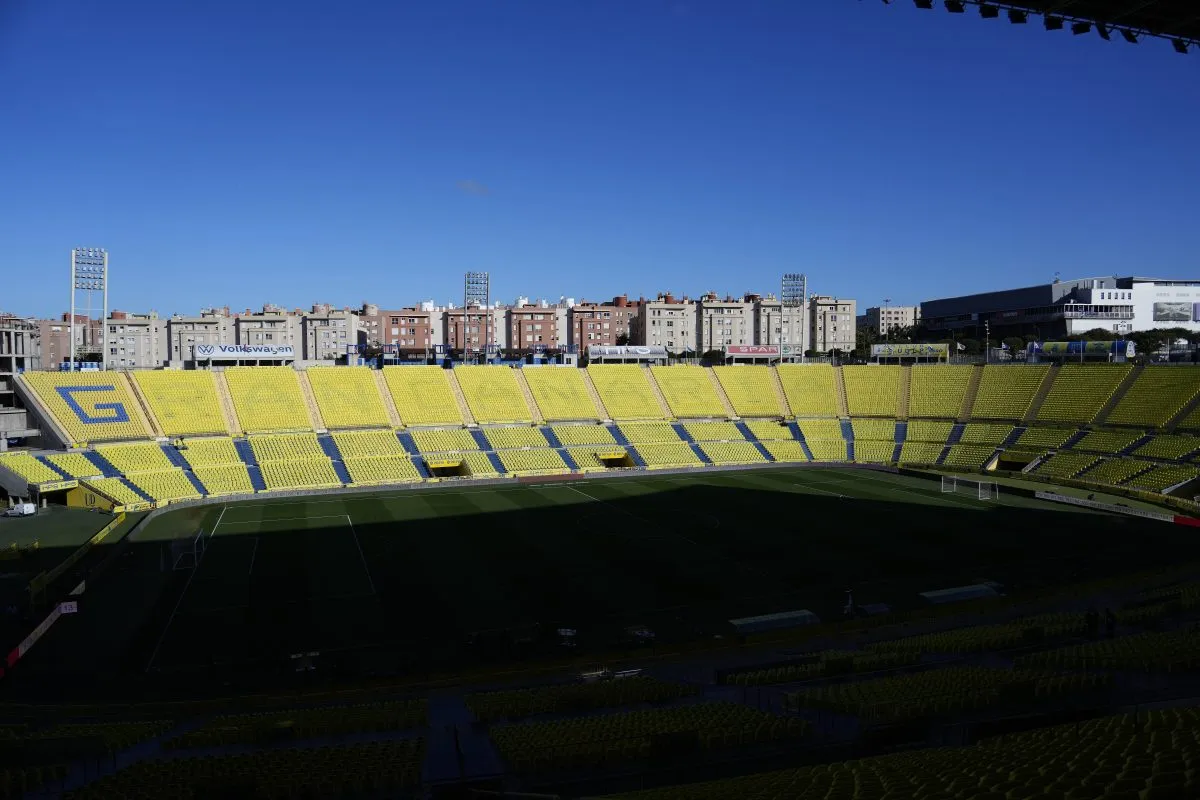
Estadio Gran Canaria's proposed £161m transformation has taken a significant step forward after construction companies OHLA and Sando were formally awarded the contract to redevelop the stadium ahead of the 2030 World Cup.
The joint venture secured the contract for €192.88m (£161m), excluding the Canary Islands' IGIC tax, following a competitive tender process overseen by the Gran Canaria Island Council's Sports Institute.
The final award was confirmed on October 28, with the consortium expected to complete the work within 30 months.
The development is intended to turn the home of UD Las Palmas into a modern international football venue, increasing its capacity from 32,418 to 44,020 and bringing its facilities in line with FIFA, UEFA and Spanish Football Federation requirements.
However, the contract still needs to be formally signed, with the necessary budget allocations for 2027, 2028 and 2029 to be consolidated before the agreement can proceed.
OHLA and Sando win £161m Estadio Gran Canaria contract
The winning bid received an overall assessment of 83.01 points out of 100, finishing ahead of competing proposals led by Ferrovial and Sacyr.
OHLA and Sando's technical submission scored 20.75 out of 25, narrowly ahead of Ferrovial's consortium on 20.50 and Sacyr's joint venture on 20.25.
The successful consortium also committed to recycling at least 85% of construction waste and using robotic demolition techniques, with the tender assessment considering safety, sustainability and waste management alongside financial and technical criteria.
The award follows an unsuccessful first tender in June, when the original €174.7m budget failed to attract any bids.
The island council subsequently increased the maximum available budget to €234.8m, approximately 34% higher than the initial allocation, prompting three construction groups to enter the second competition.
The final contract value is approximately €26.55m below the revised maximum budget, while €46.7m has been allocated for labour costs.
Estadio Gran Canaria to increase capacity to 44,020
Designed by L35 Arquitectos and Estudio 0710, the redevelopment will involve removing existing structures that need replacing, constructing new elements and installing a roof to unify the stadium's appearance.
The project will also bring the stands closer to the pitch, improving the viewing experience and creating a more compact football venue. Its proposed capacity of 44,020 will represent an increase of almost 12,000 seats.
The transformation is intended to be completed in 2029, a year before the 2030 World Cup, for which Gran Canaria is among Spain's proposed host locations.
FGG Says: Gran Canaria moves closer to its World Cup ambition
Securing a contractor removes a significant obstacle for a stadium project that initially struggled to attract construction companies. However, the formal contract and subsequent start of work remain important steps before the transformation can become reality.
If the 30-month construction schedule is maintained, Estadio Gran Canaria should have sufficient time to prepare for the 2030 tournament. For Las Palmas and the island's football supporters, the redevelopment also promises a substantially larger and more modern home beyond the World Cup.